Build Secure, Resilient and Scalable Digital Infrastructure
Modern organizations depend on cloud platforms, networks, virtualization, identity systems, automation, containers, and highly available digital services to operate efficiently and support digital transformation.
As organizations move more workloads to cloud and hybrid environments, infrastructure professionals are expected to understand not only how systems are deployed, but also how they are secured, monitored, automated, governed, optimized, and recovered during disruptions.
IBACTP® Infrastructure & Cloud training helps professionals develop the technical, operational, architectural, security, governance, and management competencies needed to design, implement, operate, secure, monitor, and scale enterprise infrastructure and cloud environments.
Training supports a broad range of learners—from systems administrators and cloud engineers to network professionals, infrastructure specialists, DevOps practitioners, cloud security professionals, IT managers, and technology leaders.
The IBACTP® Infrastructure & Cloud learning journey emphasizes:
DESIGN
DEPLOY
CONNECT
SECURE
AUTOMATE
MONITOR
SCALE
RECOVER
GOVERN
Module 02Infrastructure & Cloud Curriculum
What You Will Learn
Depending on the program, certification pathway, and professional level, IBACTP® Infrastructure & Cloud training may cover the following competency areas.
Module 03Infrastructure & Cloud Curriculum
Cloud Computing Fundamentals
Participants may develop an understanding of the foundational concepts behind cloud computing, including:
Public cloud
Private cloud
Hybrid cloud
Multi-cloud
Infrastructure as a Service
Platform as a Service
Software as a Service
Shared responsibility
Elasticity
Scalability
Resource pooling
Availability
Cloud regions and zones
Cloud service models
Cost and consumption concepts
Participants learn how cloud computing changes the way organizations acquire, deploy, secure, and manage technology resources.
Module 04Infrastructure & Cloud Curriculum
Cloud Architecture
Training may cover the principles involved in designing reliable and scalable cloud environments. Topics may include:
Cloud design principles
Compute services
Storage services
Networking
Databases
Load balancing
High availability
Fault tolerance
Resilience
Scalability
Performance
Cloud-native architecture
Service integration
Backup
Disaster recovery
Architectural trade-offs
Participants learn how architectural decisions affect security, availability, performance, cost, and operational complexity.
Module 05Infrastructure & Cloud Curriculum
Infrastructure Concepts
Training may address the core technologies that support enterprise computing environments, including:
Servers
Storage
Networks
Operating systems
Data centers
Compute resources
Memory
Storage architecture
Infrastructure services
High availability
Redundancy
Capacity planning
Performance management
Infrastructure lifecycle
Participants gain a broader understanding of how infrastructure components work together to support business applications and digital services.
Module 06Infrastructure & Cloud Curriculum
Network Architecture
Reliable cloud and enterprise environments depend on secure network design. Training may include:
LAN and WAN concepts
IP addressing
Routing
Switching
Subnets
DNS
VPNs
Load balancers
Firewalls
Network segmentation
Cloud virtual networks
Secure connectivity
Hybrid connectivity
Software-defined networking
Network monitoring
Network resilience
Participants may learn how to design connectivity that supports both performance and security requirements.
Module 07Infrastructure & Cloud Curriculum
Identity and Access Management
Identity is a core control in modern cloud and infrastructure environments. Training may cover:
Authentication
Authorization
Identity lifecycle
Role-based access control
Least privilege
Privileged access
Multifactor authentication
Single sign-on
Federation
Service accounts
Machine identities
Access reviews
Identity governance
Conditional access
Participants learn that strong identity architecture is fundamental to cloud security and Zero Trust.
Module 08Infrastructure & Cloud Curriculum
Virtualization
Virtualization enables organizations to use physical infrastructure more efficiently. Training may introduce:
Virtual machines
Hypervisors
Virtual networks
Virtual storage
Resource allocation
Consolidation
Isolation
VM lifecycle
High availability
Virtual desktop concepts
Virtualization security
Participants may explore how virtualization supports modern data centers, private clouds, and hybrid environments.
Module 09Infrastructure & Cloud Curriculum
Cloud Security
Cloud security training may address:
Shared responsibility
Identity security
Network security
Data protection
Encryption
Key management
Cloud configuration
Logging
Monitoring
Vulnerability management
Cloud workload protection
Secure APIs
Container security
Secrets management
Cloud Security Posture Management concepts
Incident response
Compliance
Security baselines
Participants learn to apply security controls throughout the cloud lifecycle.
Module 10Infrastructure & Cloud Curriculum
Cloud Monitoring
Visibility is essential to maintaining reliable and secure infrastructure. Training may include:
Metrics
Logs
Traces
Alerts
Performance monitoring
Availability monitoring
Resource monitoring
Security monitoring
Cost monitoring
Capacity monitoring
Event correlation
Dashboarding
Service health
Incident detection
Participants may learn how monitoring enables proactive detection of performance, security, and availability issues.
Module 11Infrastructure & Cloud Curriculum
Hybrid Cloud
Many organizations operate across both on-premises and cloud environments. Training may address:
Hybrid architecture
Workload placement
Connectivity
Identity integration
Data synchronization
Hybrid security
Unified monitoring
Governance
Migration
Hybrid disaster recovery
Legacy integration
Participants will understand how to manage hybrid environments as a coordinated technology ecosystem.
Module 12Infrastructure & Cloud Curriculum
Multi-Cloud
Organizations may use more than one cloud provider for resilience, specialization, regulatory, or business reasons. Training may cover:
Multi-cloud strategy
Platform differences
Identity consistency
Network integration
Security standardization
Cost management
Data portability
Monitoring
Governance
Vendor concentration risk
Operational complexity
The emphasis is on managing multi-cloud environments without sacrificing security, visibility, or control.
Module 13Infrastructure & Cloud Curriculum
DevOps Concepts
Participants may explore the relationship between development, infrastructure, automation, and operations. Topics may include:
DevOps culture
Continuous integration
Continuous delivery
Infrastructure automation
Version control
Configuration management
Release pipelines
Collaboration
Monitoring
Feedback loops
DevSecOps
Automation governance
Participants learn how DevOps practices can improve delivery speed while maintaining operational discipline.
Module 14Infrastructure & Cloud Curriculum
Infrastructure Automation
Automation can improve consistency, efficiency, and scalability. Training may include:
Infrastructure as Code concepts
Configuration automation
Provisioning
Standardized templates
Automated deployment
Policy enforcement
Repeatability
Version control
Change management
Automated remediation
Orchestration
Participants may learn how automation reduces manual errors and improves environment consistency.
Module 15Infrastructure & Cloud Curriculum
Containerization
Containers have become important for cloud-native and modern application delivery. Training may cover:
Container concepts
Images
Registries
Containers versus virtual machines
Docker concepts
Container networking
Container storage
Container security
Orchestration concepts
Kubernetes fundamentals
Scaling
Deployment patterns
Participants may learn how containerization supports portability, consistency, and scalable application deployment.
Module 16Infrastructure & Cloud Curriculum
Cloud Governance
Cloud adoption without governance can create cost, security, compliance, and operational risks. Training may include:
Cloud policies
Account and subscription structures
Resource tagging
Cost management
Security baselines
Access governance
Configuration standards
Compliance
Architecture standards
Data residency
Vendor management
Cloud risk
Governance committees
Manager-level programs may place strong emphasis on establishing enterprise cloud operating models.
Module 17Infrastructure & Cloud Curriculum
Zero Trust
Zero Trust principles are increasingly applied to infrastructure and cloud environments. Training may cover:
Verify explicitly
Least privilege
Assume breach
Identity-centric security
Device trust
Microsegmentation
Continuous authorization
Context-aware access
Data protection
Continuous monitoring
Participants may learn how to integrate Zero Trust principles into infrastructure architecture and cloud security.
Module 18Infrastructure & Cloud Curriculum
Business Continuity
Infrastructure professionals play a critical role in maintaining business services during disruption. Training may address:
Business impact analysis
Critical systems
Recovery priorities
Service dependencies
Continuity strategies
Redundancy
Alternate infrastructure
Backup
Communication
Testing
Continuity exercises
Participants learn how infrastructure design directly affects organizational continuity.
Module 19Infrastructure & Cloud Curriculum
Disaster Recovery
Disaster recovery focuses on restoring technology capabilities following major disruptions. Training may include:
Recovery Time Objectives
Recovery Point Objectives
Backup strategies
Replication
Failover
Recovery sites
Cloud disaster recovery
Data restoration
Recovery testing
Runbooks
Post-recovery review
The recovery lifecycle may follow:
PREPARE
PROTECT
FAILOVER
RESTORE
VALIDATE
IMPROVE
Module 20Infrastructure & Cloud Curriculum
Infrastructure Resilience
Resilience involves designing environments that can continue operating or recover quickly under stress. Training may address:
Redundancy
Fault tolerance
High availability
Scalability
Geographic distribution
Resilient networking
Backup
Recovery
Capacity
Incident response
Chaos-testing concepts
Dependency management
Participants learn to think beyond uptime and consider broader operational resilience.
Module 21Infrastructure & Cloud Curriculum
AI Infrastructure
Artificial Intelligence workloads create specialized infrastructure requirements. Training may include:
AI compute
GPU concepts
AI accelerators
Storage requirements
High-speed networking
Data pipelines
Model serving
Cloud AI infrastructure
Containerized AI workloads
AI platform architecture
MLOps infrastructure
AI observability
Cost optimization
AI workload security
Participants may explore how infrastructure supports model training, inference, generative AI, and enterprise AI applications.
Module 22Infrastructure & Cloud Curriculum
Professional Skills Developed
Participants in IBACTP® Infrastructure & Cloud training may develop competencies in:
Understanding cloud service models
Designing cloud and hybrid architectures
Supporting network connectivity
Managing identity and access
Understanding virtualization
Implementing cloud security controls
Monitoring infrastructure performance
Managing cloud resources
Supporting multi-cloud environments
Applying DevOps concepts
Automating infrastructure deployment
Working with containers
Understanding Kubernetes concepts
Applying Infrastructure as Code concepts
Supporting cloud governance
Implementing Zero Trust principles
Supporting business continuity
Supporting disaster recovery
Designing for resilience
Troubleshooting infrastructure issues
Evaluating scalability and availability
Supporting cloud migration
Managing infrastructure risk
Supporting AI infrastructure
Communicating infrastructure issues to stakeholders
Preparing for applicable IBACTP® Infrastructure & Cloud certifications
Professional-Level Competency Progression
DESIGN
CONFIGURE
DEPLOY
CONNECT
SECURE
MONITOR
AUTOMATE
TROUBLESHOOT
Module 23Infrastructure & Cloud Curriculum
Manager-Level Skills Developed
Manager-level training expands beyond operational administration and focuses on architecture oversight, cloud strategy, governance, risk, investment, performance, and technology leadership. Participants may develop competencies in:
Developing cloud strategies
Leading infrastructure teams
Evaluating cloud operating models
Managing cloud migration programs
Prioritizing infrastructure investments
Managing cloud cost and consumption
Establishing cloud governance
Managing identity and access strategy
Overseeing network architecture
Managing hybrid and multi-cloud risk
Governing automation
Managing cloud security programs
Developing resilience strategies
Managing business continuity and disaster recovery
Evaluating cloud vendors
Establishing infrastructure KPIs
Managing capacity and performance
Aligning infrastructure with business objectives
Communicating infrastructure risk to executives
Supporting enterprise AI infrastructure strategy
The manager-level progression emphasizes:
ASSESS
ARCHITECT
PRIORITIZE
GOVERN
MANAGE
OPTIMIZE
COMMUNICATE
LEAD
Training Formats
Module 24Infrastructure & Cloud Curriculum
Flexible, Practical and Certification-Aligned Infrastructure & Cloud Training
IBACTP® Infrastructure & Cloud training may be delivered through multiple learning formats to support technical professionals, managers, teams, and organizations.
Module 25Infrastructure & Cloud Curriculum
Virtual Instructor-Led Training (VILT)
Live online training may include:
Instructor-led lessons
Live cloud demonstrations
Network architecture examples
IAM exercises
Cloud-security demonstrations
Container demonstrations
Infrastructure automation examples
Troubleshooting scenarios
Q&A sessions
Certification preparation
This format provides real-time instructor interaction while allowing participants to attend remotely.
Module 26Infrastructure & Cloud Curriculum
Self-Paced Online Training
Self-paced programs may include:
Recorded lessons
Structured modules
Cloud demonstrations
Architecture exercises
Knowledge checks
Technical scenarios
Practice questions
Labs where available
Certification preparation
Participants can progress according to their own schedules.
Module 27Infrastructure & Cloud Curriculum
Live Classroom Instructor-Led Training
Face-to-face programs may include:
Instructor-led technical lessons
Architecture exercises
Hands-on activities
Networking scenarios
Cloud-security exercises
Automation demonstrations
Team problem solving
Case studies
Instructor coaching
Certification review
Module 28Infrastructure & Cloud Curriculum
Infrastructure & Cloud Bootcamps
IBACTP® bootcamps may provide intensive and accelerated development in areas such as:
Cloud fundamentals
Cloud architecture
Cloud security
Networking
IAM
Containers
Infrastructure automation
Hybrid cloud
Disaster recovery
Certification preparation
A typical bootcamp progression may follow:
DESIGN
DEPLOY
SECURE
AUTOMATE
MONITOR
RECOVER
Module 29Infrastructure & Cloud Curriculum
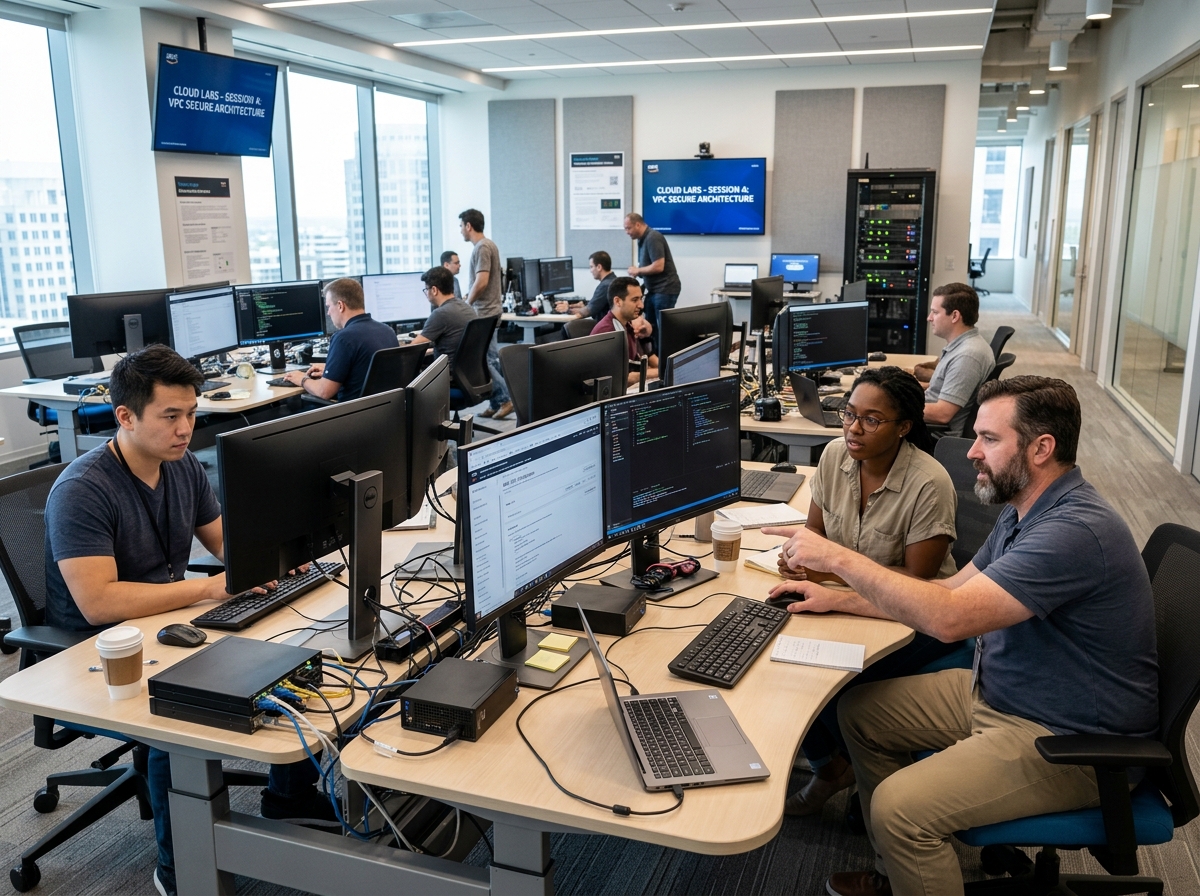
Hands-On Cloud Labs
Where applicable, participants may work in controlled lab environments involving:
Virtual machines
Cloud storage
Virtual networks
IAM
Security groups
Logging
Monitoring
Containers
Infrastructure automation
Backup
Recovery
Cloud security
Applied labs help participants build practical competency.
Module 30Infrastructure & Cloud Curriculum
Architecture Workshops
Architecture-focused workshops may require participants to design solutions involving:
High availability
Multi-tier applications
Secure networks
Hybrid cloud
Multi-cloud
Identity
Business continuity
Disaster recovery
Zero Trust
AI infrastructure
These exercises help participants understand architectural trade-offs.
Module 31Infrastructure & Cloud Curriculum
Project-Based Training
Selected programs may include projects such as:
Assess Requirements
Design Architecture
Deploy Infrastructure
Secure
Monitor
Automate
Test Recovery
Present Recommendations
This helps participants integrate multiple infrastructure and cloud competencies within an end-to-end scenario.
Module 32Infrastructure & Cloud Curriculum
Certification Preparation Programs
Certification-focused programs may include:
Body of Knowledge review
Domain-by-domain instruction
Technical scenarios
Architecture questions
Practice assessments
Case studies
Knowledge-gap analysis
Instructor review
Exam-readiness preparation
Completion of training does not automatically confer certification. Candidates must satisfy the applicable IBACTP® certification requirements.
Module 33Infrastructure & Cloud Curriculum
Hybrid Training
Hybrid learning may combine:
Self-Paced Study
Virtual Instruction
Hands-On Labs
Live Workshops
Certification Review
This model is particularly useful for technical certification pathways and corporate training cohorts.
Module 34Infrastructure & Cloud Curriculum
Infrastructure & Cloud Workshops
Focused short courses may include:
Cloud Computing Fundamentals
Cloud Architecture
Cloud Security
Identity and Access Management
Network Architecture
Hybrid Cloud
Multi-Cloud Management
DevOps Fundamentals
Infrastructure as Code
Containers and Kubernetes
Cloud Governance
Zero Trust
Business Continuity
Disaster Recovery
AI Infrastructure
Module 35Infrastructure & Cloud Curriculum
Executive Cloud & Infrastructure Education
Executive programs may be designed for:
CIOs
CTOs
IT Directors
Infrastructure leaders
Cloud leaders
Technology executives
Risk leaders
Business executives
Topics may include:
Cloud strategy
Cloud economics
Cloud governance
Technology risk
Vendor strategy
Resilience
Multi-cloud strategy
Security
AI infrastructure investment
Business continuity
Technology modernization
The emphasis is on strategic decision-making rather than day-to-day configuration.
Module 36Infrastructure & Cloud Curriculum
Corporate Infrastructure & Cloud Training
IBACTP® may provide dedicated programs for:
Cloud teams
Network teams
Infrastructure teams
Systems administration teams
DevOps teams
Security teams
Architecture teams
IT managers
Technology leaders
Programs may be delivered virtually, onsite, hybrid, or through dedicated corporate cohorts.
Module 37Infrastructure & Cloud Curriculum
Customized Enterprise Training
Organizations may request training aligned with their:
Cloud platforms
Network architecture
Technology stack
Security model
Automation strategy
Workforce roles
Resilience requirements
Compliance environment
AI infrastructure strategy
Digital transformation goals
Customized programs may combine:
Skills Assessment
Role-Based Training
Technical Labs
Architecture Exercises
Certification Preparation
Competency Assessment
Module 38Infrastructure & Cloud Curriculum
Modern Tools and Technologies
Depending on the course and learning objectives, participants may gain exposure to concepts or environments involving:
AWS
Microsoft Azure
Google Cloud
Linux
Windows Server concepts
Virtualization platforms
Docker
Kubernetes
Infrastructure as Code tools
Configuration-management tools
CI/CD platforms
Cloud monitoring tools
IAM platforms
Network-security technologies
Cloud-security tools
Backup and recovery platforms
Observability tools
Specific tools may vary by program. The emphasis remains on developing transferable infrastructure and cloud competencies.
Module 39Infrastructure & Cloud Curriculum
Standards and Framework Awareness
Where relevant, training may incorporate concepts associated with:
ISO/IEC 27001
ISO/IEC 27002
ISO 22301
ISO 31000
NIST Cybersecurity Framework
NIST Zero Trust Architecture concepts
Cloud Security Alliance guidance
CIS Controls
COBIT
IT service-management principles
Reference to an external framework indicates educational alignment and does not imply endorsement, accreditation, sponsorship, or approval unless formally documented.
Module 40Infrastructure & Cloud Curriculum
Training Delivery Options at a Glance
IBACTP® Infrastructure & Cloud training may be available through:
Virtual Instructor-Led Training (VILT)
Self-Paced Online Training
Live Classroom Instructor-Led Training
Intensive Infrastructure & Cloud Bootcamps
Hands-On Cloud Labs
Architecture Workshops
Project-Based Training
Hybrid Learning
Certification Preparation Programs
Short Courses and Specialized Workshops
Executive Cloud & Infrastructure Education
Corporate Team Training
Customized Enterprise Programs
Cohort-Based Learning
Module 41Infrastructure & Cloud Curriculum
From Infrastructure to Digital Resilience
IBACTP® Infrastructure & Cloud training helps professionals build environments that are not only functional but also secure, automated, scalable, observable, resilient, and aligned with business needs.
ARCHITECT
DEPLOY
CONNECT
SECURE
AUTOMATE
MONITOR
SCALE
RECOVER
GOVERN
LEAD
Build Stronger Infrastructure. Secure the Cloud. Enable Digital Transformation.
IBACTP® Infrastructure & Cloud Training — Developing the Professionals and Leaders Who Power the Modern Digital Enterprise.
Module 42Infrastructure & Cloud Curriculum
Cloud Security Emphasis
Training may address:
Shared responsibility
IAM
Encryption
Logging
Monitoring
Misconfiguration
Cloud workload protection
CSPM
Multi-cloud risk
Secure cloud architecture
Module 43Infrastructure & Cloud Curriculum
Technology Concepts
Participants may encounter:
AWS concepts
Microsoft Azure concepts
Google Cloud concepts
Linux
Virtualization
Containers
Kubernetes concepts
Infrastructure as Code
Cloud monitoring
Identity platforms
Zero Trust
DevOps tools
Module 44Infrastructure & Cloud Curriculum
Career Relevance
Training can support roles such as:
Cloud Engineer
Cloud Administrator
Infrastructure Engineer
Network Engineer
Cloud Security Specialist
Cloud Operations Professional
Infrastructure Manager
Cloud Security Manager
IT Infrastructure Manager
Cloud Consultant
Explore Infrastructure & Cloud Training
Build Resilient Infrastructure. Secure the Cloud. Enable Digital Business.