IBACTP® — International Board of AI, Cybersecurity & Technology Professionals
CAIEP®

Certified AI Engineering Professional

Engineer AI Systems. Deploy Intelligence. Build for Production.

Artificial Intelligence is moving rapidly from experimentation into production environments.

Lines of source code on a dark monitor
AI Engineering
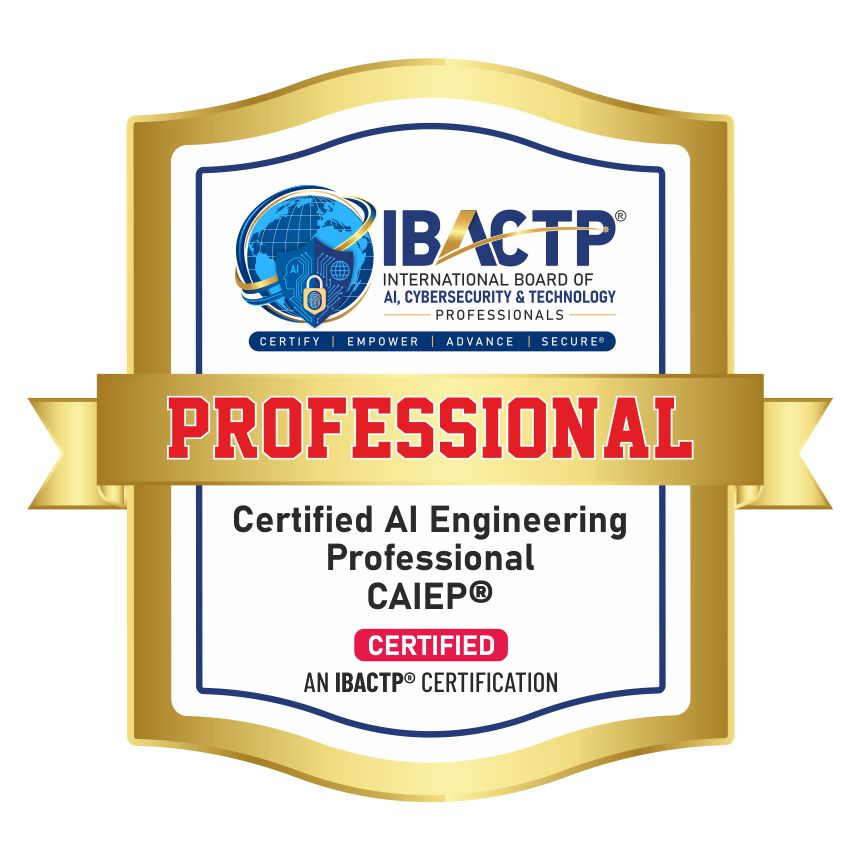
CAIEP® Certified AI Engineering Professional badge

Engineer AI Systems That Run in Production.

Professional Level For practitioners, specialists, analysts and engineers
Vendor-Neutral Skills and knowledge that apply across platforms and tools
Global Recognition Recognized internationally across industries and regions
Digital Credential Shareable, verifiable credential and certificate

What You Will Learn

Master the core areas of ai engineering.

  • 8 Comprehensive AI Engineering Modules

Module 1: AI Engineering Foundations and Systems Architecture

Learn how to design end-to-end AI architectures and translate technical and business requirements into scalable AI systems.

Module 2: Data Engineering and Feature Pipelines for AI

Build ingestion, cleaning, transformation, feature engineering, data-quality, lineage, and automated pipeline workflows.

Module 3: Machine Learning and Deep Learning Engineering

Develop, evaluate, optimize, package, and integrate machine learning and deep learning models.

Module 4: Generative AI, RAG, and AI Agent Engineering

Engineer LLM-powered applications, prompt workflows, RAG systems, vector search, AI agents, tool use, and multimodal solutions.

Module 5: AI Deployment, APIs, Cloud, and Infrastructure

Deploy models using APIs, containers, cloud services, batch and real-time inference, scalable infrastructure, and edge environments.

Module 6: MLOps, LLMOps, Monitoring, and Automation

Implement automated pipelines, model registries, versioning, observability, drift monitoring, prompt management, and lifecycle operations.

Module 7: AI Security, Responsible AI, and Engineering Risk

Secure AI systems against adversarial attacks, prompt injection, data leakage, API vulnerabilities, model exposure, and operational risk.

Module 8: Enterprise AI Integration, Reliability, and Professional Practice

Integrate AI with enterprise applications while addressing reliability, scalability, performance, cost, technical debt, and professional engineering practice.

Skills You Will Validate

By completing CAIEP®, candidates should be prepared to:

Design production-oriented AI architectures
Build AI data pipelines
Prepare and transform data
Engineer machine learning models
Integrate deep learning systems
Build LLM-powered applications
Develop RAG workflows
Engineer AI agents
Design model-serving APIs
Deploy AI applications
Containerize AI services
Support cloud AI environments
Implement MLOps
Apply LLMOps
Monitor models and applications
Detect drift and degradation
Secure AI systems
Improve reliability and scalability
Optimize AI performance and cost
Document engineering decisions

Why CAIEP® Stands Out

  • AI Architecture
  • Data Engineering
  • Machine Learning Engineering
  • Deep Learning
  • Generative AI
  • RAG
  • AI Agents
  • APIs
  • Cloud Infrastructure
  • MLOps
  • LLMOps
  • Cybersecurity
  • Reliability Engineering
Get Started Today

Career Opportunities

CAIEP® can support advancement toward roles such as:

  • AI Engineer
  • Machine Learning Engineer
  • Generative AI Engineer
  • AI Solutions Engineer
  • AI Application Engineer
  • MLOps Engineer
  • LLMOps Engineer
  • AI Platform Engineer
  • AI Integration Engineer
  • AI Systems Engineer
  • Cloud AI Engineer
  • AI Infrastructure Engineer
  • AI Automation Engineer
  • Data Engineer
  • AI Developer
  • AI Reliability Engineer
  • AI Security Engineer
  • AI Technical Consultant
  • Enterprise AI Engineer

Actual role eligibility depends on professional experience, education, technical skills, and employer requirements.

View Career Outlook
About the credential

Become an AI Engineering professional the market trusts.

Organizations now need professionals who can do more than build models. They need engineers who can design AI architectures, manage data pipelines, integrate machine learning and Generative AI, deploy models securely, build APIs, implement MLOps and LLMOps, monitor performance, and maintain reliable AI systems at scale.

The Certified AI Engineering Professional (CAIEP®) is a professional technical certification designed to validate practical, vendor-neutral competency in the engineering, deployment, integration, security, and lifecycle management of Artificial Intelligence systems.

Offered by the: International Board of AI, Cybersecurity & Technology Professionals (IBACTP®)

CAIEP® validates the skills needed to transform AI models and prototypes into secure, scalable, production-ready enterprise solutions.

Lines of source code on a dark monitor

Professional level — Three-year certification cycle with continuing professional education

Build the Engineering Skills Behind Production AI

  • AI Architecture
  • Data Engineering
  • Machine Learning
  • Generative AI
  • RAG
  • AI Agents
  • APIs
  • Cloud
  • MLOps
  • LLMOps
  • AI Security
  • Reliability

Start Your CAIEP® Journey

  • APPLY FOR CERTIFICATION
  • REGISTER FOR THE CAIEP® EXAM
  • ENROLL IN TRAINING
  • CHOOSE THE CAPSTONE PATHWAY
  • DOWNLOAD THE CERTIFICATION GUIDE
Lines of source code on a dark monitor
CAIEP®

Why Earn the CAIEP® Certification?

Building an AI model is only one part of delivering a successful AI solution.

Production AI requires professionals who understand how to connect data, models, applications, infrastructure, APIs, cloud platforms, monitoring, security, and operational processes.

CAIEP® is designed for professionals who want to demonstrate competency across the full AI engineering lifecycle.

The certification validates professional skills in:

  • AI systems architecture
  • Data engineering for AI
  • Feature pipelines
  • Machine learning engineering
  • Deep learning engineering
  • Generative AI application engineering
  • Large Language Model integration
  • Retrieval-Augmented Generation
  • AI agents
  • API development
  • Cloud AI deployment
  • Containers
  • Model serving
  • MLOps
  • LLMOps
  • Monitoring and observability
  • AI security
  • Responsible AI engineering
  • Reliability and resilience
  • Enterprise integration
CAIEP®

Who Should Earn CAIEP®?

CAIEP® is designed for professionals responsible for developing, integrating, deploying, or supporting AI-enabled systems.

Ideal candidates include:

  • AI Engineers
  • Machine Learning Engineers
  • Generative AI Engineers
  • AI Solutions Engineers
  • AI Application Developers
  • Software Engineers
  • Data Engineers
  • Data Scientists
  • Cloud Engineers
  • MLOps Engineers
  • LLMOps Engineers
  • DevOps Engineers
  • DevSecOps Professionals
  • Platform Engineers
  • Systems Engineers
  • Backend Developers
  • API Developers
  • Automation Engineers
  • Cybersecurity Engineers
  • Enterprise Architects
  • Technical Consultants
  • AI Implementation Specialists
  • Technology Professionals transitioning into AI engineering
CAIEP®

CAIEP® Course Learning Outcomes

Upon successful completion of the Certified AI Engineering Professional (CAIEP®) course, participants will be able to:

  1. 01

    Design AI Systems and Engineering Architectures

    Translate technical and business requirements into end-to-end AI architectures that integrate data, models, APIs, applications, infrastructure, security, and monitoring.

  2. 02

    Build Data and Feature Pipelines for AI

    Prepare, transform, validate, and manage data used in AI systems while applying feature engineering, data-quality, lineage, versioning, and pipeline automation practices.

  3. 03

    Develop and Integrate Machine Learning and Deep Learning Models

    Select appropriate algorithms, train and evaluate models, optimize performance, package model artifacts, and integrate machine learning and deep learning into applications.

  4. 04

    Engineer Generative AI, RAG, and AI Agent Solutions

    Develop LLM-powered applications using prompt engineering, embeddings, vector databases, Retrieval-Augmented Generation, AI agents, tool integration, and multimodal AI.

  5. 05

    Deploy AI Applications, APIs, and Cloud-Based Services

    Package and deploy AI systems using APIs, containers, model-serving environments, cloud infrastructure, batch and real-time inference, and scalable deployment patterns.

  6. 06

    Apply MLOps, LLMOps, Monitoring, and Lifecycle Management

    Implement model and prompt versioning, automated pipelines, model registries, observability, drift detection, retraining, release management, and continuous improvement.

  7. 07

    Engineer Secure, Responsible, and Reliable AI Systems

    Identify and mitigate AI security, privacy, adversarial, API, prompt, model, data, and operational risks while applying responsible AI and reliability principles.

  8. 08

    Optimize and Integrate Enterprise AI Solutions

    Evaluate performance, scalability, availability, cost, technical debt, maintainability, and enterprise integration requirements for production AI systems.

CAIEP®

CAIEP® Certification Testing Outcomes — Skills and Competencies Tested

The Certified AI Engineering Professional (CAIEP®) certification assessment is designed to evaluate applied technical knowledge, engineering judgment, system-design capability, troubleshooting skills, security awareness, deployment competency, and production AI engineering practices.

Candidates are expected to demonstrate competency across the following eight domains:

01 / 08

1. AI Engineering Foundations and Systems Architecture

Candidates should be able to:

Competency Tested: Ability to translate AI requirements into a technically sound system architecture.

  • Interpret AI solution requirements
  • Identify major system components and dependencies
  • Select appropriate architecture patterns
  • Design data, model, application, and infrastructure layers
  • Evaluate scalability, availability, latency, and reliability requirements
  • Document technical architecture and engineering decisions
02 / 08

2. Data Engineering and Feature Pipelines

Candidates should be able to:

Competency Tested: Ability to build reliable data pipelines that support AI and machine learning systems.

  • Ingest data from multiple sources
  • Clean and transform datasets
  • Apply feature engineering techniques
  • Validate data quality
  • Design batch and streaming pipelines
  • Apply data versioning, lineage, and reproducibility controls
03 / 08

3. Machine Learning and Deep Learning Engineering

Candidates should be able to:

Competency Tested: Ability to engineer machine learning and deep learning models into usable technical solutions.

  • Select appropriate machine learning approaches
  • Train and validate models
  • Evaluate performance using suitable metrics
  • Apply model optimization techniques
  • Work with deep learning architectures
  • Package and integrate model artifacts
04 / 08

4. Generative AI, RAG, and AI Agent Engineering

Candidates should be able to:

Competency Tested: Ability to engineer practical Generative AI and agentic applications.

  • Integrate foundation models and LLMs
  • Design structured prompt workflows
  • Build or evaluate RAG pipelines
  • Use embeddings and vector retrieval
  • Develop AI agents with tool access
  • Apply human approval and workflow controls
05 / 08

5. AI Deployment, APIs, Cloud, and Infrastructure

Candidates should be able to:

Competency Tested: Ability to deploy and integrate AI systems in production environments.

  • Expose AI models through APIs
  • Containerize AI applications
  • Deploy workloads to cloud environments
  • Support batch and real-time inference
  • Evaluate model-serving architectures
  • Apply scalable deployment and infrastructure principles
06 / 08

6. MLOps, LLMOps, Monitoring, and Automation

Candidates should be able to:

Competency Tested: Ability to operate, monitor, and maintain AI systems throughout their production lifecycle.

  • Implement model, code, data, and prompt versioning
  • Build automated training and deployment workflows
  • Use model registries
  • Monitor performance and drift
  • Evaluate RAG and LLM behavior
  • Define retraining and lifecycle processes
07 / 08

7. AI Security, Responsible AI, and Engineering Risk

Candidates should be able to:

Competency Tested: Ability to engineer AI systems securely and responsibly.

  • Identify AI attack surfaces
  • Assess data poisoning and adversarial risks
  • Recognize prompt injection and model-exposure threats
  • Secure APIs and access controls
  • Protect sensitive data
  • Apply responsible AI, privacy, fairness, and safety controls
08 / 08

8. Enterprise Integration, Reliability, and Performance Engineering

Candidates should be able to:

Competency Tested: Ability to engineer sustainable, reliable, and scalable enterprise AI solutions.

  • Integrate AI with enterprise applications and systems
  • Evaluate reliability and resilience requirements
  • Measure latency, throughput, and resource utilization
  • Assess scalability and cost
  • Address technical debt and maintainability
  • Communicate engineering recommendations to stakeholders

Swipe or scroll sideways to see each part →

CAIEP®

The CAIEP®–IBACTP® AI Engineering Competency Model

The CAIEP®–IBACTP® AI Engineering Competency Model is built around eight integrated technical domains.

1. AI Architecture Competency

Design end-to-end AI solutions that integrate data, models, applications, APIs, infrastructure, security, and monitoring.

2. Data Engineering Competency

Build reliable ingestion, preprocessing, feature engineering, data-quality, lineage, and pipeline workflows.

3. Model Engineering Competency

Develop, evaluate, optimize, package, and integrate machine learning and deep learning models.

4. Generative AI Engineering Competency

Engineer LLM applications, prompt workflows, RAG systems, vector search, AI agents, and multimodal AI solutions.

5. Deployment and Infrastructure Competency

Deploy AI systems through APIs, containers, cloud environments, edge platforms, and scalable model-serving architectures.

6. AI Operations Competency

Apply MLOps, LLMOps, monitoring, observability, versioning, automation, retraining, and lifecycle management.

7. Secure and Responsible Engineering Competency

Identify and mitigate AI security, privacy, adversarial, data, API, prompt, model, and responsible AI risks.

8. Enterprise Reliability Competency

Engineer AI systems for reliability, maintainability, scalability, availability, cost efficiency, and enterprise integration.

CAIEP® Engineering Progression

Design → Build → Integrate → Deploy → Automate → Monitor → Secure → Optimize

CAIEP®

CAIEP® Production AI Engineering Capstone

Candidates selecting the applied pathway complete a structured:

CAIEP®

Production AI Engineering Capstone Project

The capstone evaluates the candidate's ability to engineer a complete AI solution.

01 / 03

Part 1: Architecture, Data, and Solution Engineering

Candidates:

  • Define technical requirements
  • Design AI architecture
  • Identify data sources
  • Build or specify data pipelines
  • Select model approaches
  • Define APIs
  • Establish integration requirements
02 / 03

Part 2: Model Integration, Security, and Production Readiness

Candidates:

  • Integrate models
  • Evaluate performance
  • Secure APIs
  • Protect data
  • Apply responsible AI
  • Establish testing
  • Implement monitoring
  • Define operational controls
03 / 03

Part 3: Deployment, MLOps, Reliability, and Engineering Presentation

Candidates:

  • Define deployment strategy
  • Establish CI/CD
  • Manage model versions
  • Define drift monitoring
  • Establish retraining
  • Evaluate scalability
  • Optimize cost
  • Present engineering decisions

Swipe or scroll sideways to see each part →

CAIEP®

CAIEP® Certification Competency Standard

The CAIEP® assessment is designed to measure more than familiarity with AI engineering terminology.

Successful candidates should demonstrate the ability to apply technical knowledge and engineering judgment to realistic production AI scenarios.

The competency progression is:

Design → Build → Integrate → Deploy → Automate → Monitor → Secure → Optimize

Candidates may be evaluated through technical scenario-based examination questions, practical engineering exercises, or the CAIEP® Production AI Engineering Capstone Project.

The assessment should determine whether a candidate can make appropriate engineering decisions involving:

  • AI architecture
  • Data pipelines
  • Machine learning models
  • Deep learning
  • Generative AI
  • Retrieval-Augmented Generation
  • AI agents
  • APIs
  • Cloud infrastructure
  • MLOps
  • LLMOps
  • Cybersecurity
  • Reliability
  • Scalability
  • Cost
  • Enterprise integration
CAIEP®

What CAIEP® Validates

Earning the Certified AI Engineering Professional (CAIEP®) designation demonstrates professional competency in transforming AI concepts and models into secure, reliable, scalable, and production-ready systems.

CAIEP® validates the ability to:

This differentiates CAIEP® from broad AI practitioner credentials by emphasizing engineering implementation, deployment, operations, security, and production readiness.

  • Design AI Architectures
  • Build Data Pipelines
  • Engineer Machine Learning Models
  • Develop GenAI and RAG Applications
  • Integrate AI Agents
  • Deploy AI Services
  • Implement MLOps and LLMOps
  • Monitor Production AI
  • Secure AI Systems
  • Optimize Reliability, Scale, and Cost
CAIEP®

Hands-On Practical Labs

CAIEP® includes five integrated engineering labs designed to connect technical theory with real-world implementation.

01 / 05

Lab 1: Data Pipeline and Machine Learning Engineering

Candidates build an end-to-end workflow involving:

  • Data ingestion
  • Data cleaning
  • Feature engineering
  • Model training
  • Evaluation
  • Model packaging
02 / 05

Lab 2: Generative AI and RAG Application Engineering

Candidates develop an LLM-powered knowledge application using:

  • Prompt templates
  • Document ingestion
  • Embeddings
  • Vector retrieval
  • RAG
  • Grounded response evaluation
03 / 05

Lab 3: AI Agent and API Integration

Candidates design a tool-enabled AI workflow involving:

  • Agent objectives
  • API access
  • Structured outputs
  • Tool use
  • Human approval
  • Agent behavior evaluation
04 / 05

Lab 4: AI Deployment, Containerization, and Monitoring

Candidates deploy an AI service and evaluate:

  • Model serving
  • APIs
  • Containerization
  • Runtime configuration
  • Logging
  • Latency
  • Monitoring
05 / 05

Lab 5: AI Security and Production Readiness Assessment

Candidates assess a simulated AI system for:

  • Security gaps
  • API risks
  • Prompt injection
  • Access controls
  • Privacy
  • Monitoring
  • Production readiness

Swipe or scroll sideways to see each part →

Assessment

Flexible Certification Assessment Options

CAIEP® offers two ways to demonstrate competency.

Option 1

Option 1: CAIEP® Certification Examination

Recommended structure:

The examination evaluates:

Knowledge • Application • Architecture • Troubleshooting • Deployment • Security • Engineering Judgment

  • 100 questions
  • Multiple-choice and technical scenario-based questions
  • 150 minutes
  • Closed book
  • Secure online proctoring or approved testing center
  • Recommended passing score: 70%
Option 2

Option 2: Production AI Engineering Capstone

Candidates may demonstrate competency through a practical engineering project covering:

  • Architecture
  • Data engineering
  • Model integration
  • APIs
  • RAG or Generative AI where applicable
  • Deployment
  • MLOps
  • Monitoring
  • Security
  • Reliability
  • Scalability
  • Documentation
CAIEP®

Recommended Training Duration · Certification Validity · Continuing Professional Education

Recommended Training Duration

CAIEP® is designed as a comprehensive:

Certification Validity

The recommended certification cycle is:

Continuing Professional Education

Recommended renewal requirement:

CAIEP®

40 CPE Credits Every Three Years

Qualifying professional development may include:

  • AI engineering courses
  • Machine learning training
  • Generative AI development
  • MLOps education
  • LLMOps training
  • Cloud architecture
  • DevOps
  • DevSecOps
  • AI security training
  • Professional conferences
  • AI engineering projects
  • Teaching
  • Research
  • Publications
  • Advanced certifications
Where it leads

Professional Designation

Successful candidates earn the professional designation:

AI Engineering

ISO and International Framework Alignment

The CAIEP® Body of Knowledge is designed with consideration of recognized standards and frameworks relevant to AI, software engineering, cybersecurity, privacy, risk, and professional certification.

Relevant standards and frameworks include:

ISO/IEC 42001

Artificial Intelligence Management Systems.

Supports governance, accountability, AI risk management, lifecycle oversight, and continual improvement.

ISO/IEC 23894

Artificial Intelligence Risk Management.

Supports identification, evaluation, treatment, monitoring, and communication of AI risks.

ISO/IEC 22989

Artificial Intelligence Concepts and Terminology.

Provides standardized AI terminology and foundational concepts.

ISO/IEC 27001

Information Security Management Systems.

Supports secure engineering, access control, data protection, risk management, and incident response.

ISO/IEC 27701

Privacy Information Management.

Supports privacy requirements for AI systems handling personal or sensitive information.

ISO/IEC 25010

Systems and Software Quality Models.

Supports quality considerations involving reliability, performance, security, maintainability, usability, and compatibility.

ISO/IEC 12207

Software Lifecycle Processes.

Supports structured software and systems lifecycle practices applicable to AI engineering.

ISO 31000

Risk Management.

Supports structured engineering and operational risk management.

ISO/IEC 17024

Certification of Persons.

Provides internationally recognized principles for personnel certification.

NIST AI Risk Management Framework

Supports governance and management of AI-related risks.

CAIEP®

Global, Vendor-Neutral Focus

CAIEP® is designed as an internationally relevant and vendor-neutral AI engineering certification.

Its competencies are intended to transfer across:

This allows professionals to apply the CAIEP® Body of Knowledge across different technology ecosystems.

  1. 01

    AI frameworks

    Programming environments

  2. 02

    Cloud providers

    Model providers

  3. 03

    Data platforms

    Enterprise architectures

  4. 04

    Countries

    Industries

CAIEP®

Global Recognition and Professional Portability

The CAIEP® certification is designed to support professional mobility and demonstrate AI engineering competency across industries and geographic markets.

Relevant sectors include:

Recognition remains subject to the hiring, regulatory, educational, or professional requirements of individual organizations.

  • Technology
  • Financial Services
  • Cybersecurity
  • Healthcare
  • Government
  • Telecommunications
  • Manufacturing
  • Energy
  • Education
  • Retail
  • Supply Chain
  • Transportation
  • Consulting
  • Information Technology
  • Information Systems
  • Data and Analytics
  • Professional Services
CAIEP®

Accreditation and Credentialing Alignment

CAIEP® is designed with consideration of professional personnel-certification and credentialing principles associated with:

The certification framework should incorporate:

Formal accreditation should only be claimed after officially awarded.

  • ISO/IEC 17024
  • ANSI National Accreditation Board (ANAB)
  • National Commission for Certifying Agencies (NCCA)
  • Institute for Credentialing Excellence (I.C.E.)
  • International conformity-assessment practices
  • Job Task Analysis
  • Defined competency requirements
  • Validated Body of Knowledge
  • Examination blueprint
  • Subject Matter Expert participation
  • Psychometric review
  • Candidate identity verification
  • Examination security
  • Impartial certification decisions
  • Appeals and complaints
  • Code of professional conduct
  • Continuing Professional Education
  • Recertification
  • Credential verification
  • Continuous improvement
CAIEP®

Your AI Engineering Certification Pathway

  • Professional Level
CAIEP®

CAIP® vs. CAIEP®

AreaCAIP®CAIEP®
Focus Broad AI professional competency Technical AI engineering
Programming Foundational Important
Data Engineering Awareness Core
ML Development Applied understanding Engineering implementation
Generative AI Professional use Application engineering
RAG Understanding Design and implementation
AI Agents Applied concepts Engineering and integration
APIs Awareness Core
Cloud General Strong emphasis
MLOps Understanding Core competency
LLMOps Understanding Core competency
Security Risk awareness Secure engineering
Reliability Limited Core
Primary Outcome AI professional AI engineer
CAIEP®

Choose Your Next Step

APPLY FOR CAIEP® CERTIFICATION

Ready to validate your AI engineering competency?

APPLY NOW →

REGISTER FOR THE CAIEP® EXAM

Already prepared?

Demonstrate your technical competency through the CAIEP® Certification Examination.

REGISTER FOR THE EXAM →

ENROLL IN CAIEP® TRAINING

Develop end-to-end AI engineering skills across all eight competency domains.

ENROLL NOW →

CHOOSE THE ENGINEERING CAPSTONE

Prefer applied assessment?

Demonstrate your engineering skills through the CAIEP® Production AI Engineering Capstone Project.

START YOUR CAPSTONE →

DOWNLOAD THE CAIEP® CERTIFICATION GUIDE

Review:

DOWNLOAD PROGRAM GUIDE →

  • Eligibility
  • Body of Knowledge
  • Training structure
  • Practical labs
  • Assessment options
  • Exam requirements
  • Capstone requirements
  • Renewal
  • Professional designation
CAIEP®

Recommended Background

CAIEP® is a professional technical certification.

Candidates should preferably have familiarity with some of the following:

Advanced AI research experience is not required.

  • Python or another programming language
  • Databases
  • APIs
  • Data structures
  • Machine learning fundamentals
  • Cloud concepts
  • Version control
  • Software engineering
  • Basic cybersecurity
  • AI or data technologies
CAIEP®

Tools, Technologies, and Engineering Environments

CAIEP® is vendor-neutral but exposes candidates to the major categories of technologies used in modern AI engineering.

Depending on the approved training environment, candidates may gain experience with:

Programming and Development

  • Python
  • Jupyter
  • Git
  • SQL
  • JSON
  • REST APIs
  • SDKs
  • Command-line environments

Machine Learning

  • scikit-learn
  • TensorFlow
  • PyTorch
  • Classification
  • Regression
  • Clustering
  • Feature engineering
  • Model evaluation
  • Experiment tracking

Generative AI

  • Large Language Models
  • Foundation models
  • Prompt templates
  • Embeddings
  • Vector databases
  • Retrieval-Augmented Generation
  • AI agents
  • Tool-enabled AI
  • Multimodal models

Data Engineering

  • Databases
  • Data warehouses
  • Data lakes
  • ETL and ELT workflows
  • Batch processing
  • Streaming concepts
  • Feature stores
  • Data-quality controls

AI Deployment

  • APIs
  • Containers
  • Container registries
  • Model endpoints
  • Cloud AI services
  • Serverless concepts
  • Edge AI
  • Scalable inference

MLOps and LLMOps

  • Model registries
  • Version control
  • Automated pipelines
  • Experiment tracking
  • Prompt versioning
  • RAG monitoring
  • Drift detection
  • Observability
  • Logging
  • Evaluation pipelines

Infrastructure and Security

The certification focuses on transferable engineering practices rather than one specific platform or vendor.

  • Cloud compute
  • GPUs
  • Storage
  • Networking
  • Identity and access management
  • Secrets management
  • Encryption
  • API security
  • Monitoring
  • Incident response
CAIEP®

AI Engineering Applications

CAIEP® competencies are relevant to AI systems such as:

  • Predictive analytics
  • Fraud detection
  • Recommendation systems
  • Cybersecurity analytics
  • Image recognition
  • Computer vision systems
  • NLP applications
  • Intelligent document processing
  • Generative AI assistants
  • Enterprise copilots
  • RAG knowledge assistants
  • AI-powered search
  • AI agents
  • Workflow automation
  • Intelligent customer support
  • Predictive maintenance
  • AI APIs
  • Decision-support systems
  • Cloud AI applications
  • Edge AI
  • Enterprise automation
CAIEP®

Secure AI Engineering Focus

AI engineering introduces new attack surfaces across models, APIs, data pipelines, cloud infrastructure, RAG systems, agents, and third-party dependencies.

CAIEP® addresses security risks such as:

Candidates learn to apply security thinking across the complete AI engineering lifecycle.

  • Data poisoning
  • Adversarial examples
  • Model theft
  • Model extraction
  • Training-data leakage
  • Prompt injection
  • Indirect prompt injection
  • Jailbreaking
  • Sensitive information exposure
  • API vulnerabilities
  • Secrets exposure
  • Excessive agency
  • Unauthorized tool use
  • Third-party AI risk
CAIEP®

Responsible AI Engineering

CAIEP® treats responsible AI as an engineering requirement.

Candidates learn to consider:

Responsible AI should be engineered into systems rather than treated as an afterthought.

  • Fairness
  • Bias
  • Explainability
  • Transparency
  • Privacy
  • Safety
  • Human oversight
  • Reliability
  • Accountability
  • Responsible deployment
  • Data protection
  • Monitoring
CAIEP®

Production AI and Reliability Focus

Production AI systems must remain dependable after deployment.

CAIEP® addresses:

  • Availability
  • Latency
  • Throughput
  • Model degradation
  • Data drift
  • Concept drift
  • Fault tolerance
  • Logging
  • Observability
  • Alerts
  • Retraining
  • Rollback
  • Incident response
  • Disaster recovery
  • Model retirement
CAIEP®

Certified AI Engineering Professional (CAIEP®)

Active credential holders may use the designation after their names according to IBACTP® certification policies.

Example

Jane Smith, CAIEP®

The designation demonstrates professional competency in AI architecture, development, integration, deployment, MLOps, security, reliability, and enterprise AI engineering.

CAIEP®

CAIEP®

Certified AI Engineering Professional

Develop and validate professional competency in:

  • Architecture
  • Data pipelines
  • ML engineering
  • Generative AI
  • RAG
  • AI agents
  • APIs
  • Cloud
  • MLOps
  • Security
  • Reliability
  • Advanced Manager Level
CAIEP®

One Credential. End-to-End AI Engineering Competency.

8 Technical Modules

From architecture through enterprise integration.

5 Practical Engineering Labs

Apply AI engineering in realistic technical environments.

2 Assessment Pathways

Certification Examination or Production Engineering Capstone.

1 Professional Designation

CAIEP® — Certified AI Engineering Professional

CAIEP®

Engineer AI That Works Beyond the Prototype. · Certified AI Engineering Professional (CAIEP®)

Engineer AI That Works Beyond the Prototype.

Design It. Build It. Integrate It. Deploy It. Secure It. Monitor It. Scale It.

Certified AI Engineering Professional (CAIEP®)

Offered by the International Board of AI, Cybersecurity & Technology Professionals (IBACTP®)

Design AI. Engineer Intelligence. Deploy Securely. Scale with Confidence.

The examination

Exam & Certification Details

Everything you need to plan your sitting.

CAIEP-100

Exam code for the Professional-level AI Engineering credential.

100 questions (maximum)

Multiple choice, completed in 120 minutes.

700 out of 1000

Passing score. Delivered in English.

Recommended experience

A minimum of two years of experience in ai engineering or a closely related technology discipline.

Where you sit it

IBACTP® approved testing centers and online proctored delivery

Staying certified

Three-year certification cycle with continuing professional education

Choose your route

Four ways to enroll. One credential.

Every route leads to the same CAIEP® examination and the same designation.

Option 1

Self-Paced Learning

Self-study
$400 USD
  • Exam fee only
  • Complimentary course materials provided
Option 2

Virtual Instructor-Led Training

4 days
$1,200 USD
  • 4 days, 2 hours daily online
  • Includes all course materials + Exam
Select a Date and Purchase
Option 3

Bootcamps & Intensives

10 days
$1,800 USD
  • 10 days, 2 hours daily
  • Includes all course materials + Exam
Select a Date and Purchase
Option 4

Corporate Training

Your schedule
Fees negotiable
  • Certify a whole team on a schedule that suits your organization
  • Fees depend on the team's size / number
Request a Team Quote
Questions

Frequently Asked Questions — CAIEP®

What is CAIEP®?

CAIEP® is a professional AI engineering certification focused on designing, building, integrating, deploying, securing, monitoring, and maintaining production AI systems.

Who should take CAIEP®?

It is designed for AI engineers, software developers, data engineers, ML engineers, cloud professionals, MLOps professionals, systems engineers, and technical consultants.

Is programming required?

Basic programming knowledge is strongly recommended. Python is commonly used in AI engineering, although the certification remains vendor- and language-neutral.

Does CAIEP® cover Generative AI?

Yes. The program covers LLM integration, prompt engineering, RAG, vector databases, AI agents, multimodal AI, and LLMOps.

Does CAIEP® include machine learning?

Yes. Machine learning and deep learning engineering are major components.

Does CAIEP® cover RAG?

Yes. Candidates learn document ingestion, chunking, embeddings, vector retrieval, grounding, and RAG evaluation.

Are AI agents included?

Yes. Candidates study agent goals, tools, memory, workflows, orchestration, permissions, human approval, and security.

Does CAIEP® cover cloud deployment?

Yes. Cloud, containers, APIs, model serving, scalable infrastructure, and edge concepts are included.

Does CAIEP® cover MLOps?

Yes. MLOps is a core competency area.

Does it include AI security?

Yes. CAIEP® addresses model security, API security, adversarial AI, prompt injection, access control, privacy, and production security.

Is CAIEP® vendor-neutral?

Yes.

How long is training?

The recommended program is approximately 60 hours.

How is CAIEP® assessed?

Candidates may choose the Certification Examination or Production AI Engineering Capstone.

How long is the certification valid?

The recommended certification cycle is three years.

What certification comes after CAIEP®?

The advanced progression is:

Certified AI Engineering Manager (CAIEM®)

CAIEP®

Ready to Engineer the Future of AI?

Become CAIEP® Certified.

Organizations need professionals who can transform AI from an experiment into a dependable production capability.

CAIEP® is designed for professionals ready to:

  • Design AI Systems
  • Build Data Pipelines
  • Engineer Models
  • Integrate Generative AI
  • Build RAG Applications
  • Deploy AI Agents
  • Operate MLOps
  • Secure Production AI
  • Scale Enterprise Solutions

Certified AI Engineering Professional (CAIEP®) · International Board of AI, Cybersecurity & Technology Professionals (IBACTP®)

28+ Certifications
14 Technology Disciplines
Global Recognition
Industry Validated
Your Career Our Mission