Develop the Skills to Use, Govern and Secure Generative AI
Generative AI is transforming content creation, analytics, software development, customer service, research, automation, knowledge management, and enterprise decision support.
IBACTP® Generative AI training helps professionals understand how large language models and related technologies work, how to apply them effectively, and how to manage their risks.
Module 02Generative AI Curriculum
What You Will Learn
IBACTP® Generative AI training helps professionals move beyond basic AI awareness and develop practical, strategic, and governance-focused competencies to use generative AI responsibly and effectively in real organizational environments. Depending on the training level, participants may learn how to evaluate, apply, integrate, secure, and govern generative AI systems across business, technical, operational, and leadership contexts.
Module 03Generative AI Curriculum
Generative AI Foundations
Participants may develop an understanding of:
What generative AI is and how it differs from traditional AI and machine learning
Major generative AI use cases
Foundation models
Multimodal AI
Text, image, audio, and code generation
Enterprise applications of generative AI
Benefits, limitations, and organizational risks
Module 04Generative AI Curriculum
Large Language Models
Training may cover:
How large language models work at a conceptual level
Tokens, context windows, and model inference
Model training and fine-tuning concepts
Foundation models versus specialized models
Model selection considerations
Proprietary versus open-source models
Model capabilities and limitations
Evaluating model outputs
Module 05Generative AI Curriculum
Prompt Engineering
Participants may learn how to design effective prompts for professional use cases, including:
Instruction prompting
Role prompting
Context setting
Few-shot prompting
Structured output prompting
Constraint-based prompting
Iterative prompt improvement
Prompt evaluation
Prompt testing
Prompt libraries
Module 06Generative AI Curriculum
Prompt Design Patterns
Training may introduce reusable prompt strategies for:
Summarization
Classification
Data extraction
Analysis
Brainstorming
Decision support
Report generation
Coding assistance
Research
Customer service
Knowledge retrieval
Business process automation
Participants may also learn when complex prompt structures add value and when simpler prompts work better.
Module 07Generative AI Curriculum
AI Copilots
Participants may explore how AI copilots can support:
Knowledge workers
Software developers
Cybersecurity teams
Data professionals
Customer-service teams
HR professionals
Finance teams
Procurement teams
Executives
Project managers
Training may address human oversight, workflow integration, data protection, and responsible use.
Module 08Generative AI Curriculum
Retrieval-Augmented Generation
Participants may develop an understanding of Retrieval-Augmented Generation, or RAG, including:
Why RAG is used
Connecting AI models to organizational knowledge
Document retrieval
Knowledge grounding
Context injection
Search and retrieval concepts
Reducing unsupported responses
Enterprise knowledge assistants
RAG architecture fundamentals
Module 09Generative AI Curriculum
Embeddings
Training may introduce embeddings as a way to represent semantic meaning in a form AI systems can use.
Topics may include:
Embedding concepts
Semantic similarity
Search
Classification
Clustering
Knowledge retrieval
Document matching
Recommendation use cases
Module 10Generative AI Curriculum
Vector Databases
Participants may learn the role of vector databases in modern generative AI systems, including:
Vector storage
Semantic search
Similarity retrieval
Document indexing
RAG applications
Knowledge-base integration
Scalability considerations
Module 11Generative AI Curriculum
AI Agents
Training may cover emerging AI agent concepts, including:
Agent architecture
Goal-directed AI behavior
Tool use
Planning
Memory
Multi-step workflows
Human-in-the-loop controls
Multi-agent systems
Agentic automation
Enterprise agent governance
Participants may also examine the risks associated with giving AI agents access to tools, systems, data, and decision-making authority.
Module 12Generative AI Curriculum
Enterprise Generative AI
Participants may learn how organizations evaluate and deploy generative AI at scale. Topics may include:
Enterprise use-case identification
Business-value assessment
AI maturity
Model selection
Platform selection
Data integration
Security requirements
Governance
Change management
Adoption
Measurement of business value
Enterprise AI operating models
Module 13Generative AI Curriculum
Generative AI Automation
Training may address how generative AI can be combined with workflow technologies to automate tasks such as:
Document processing
Email summarization
Report creation
Knowledge retrieval
Customer support
Data extraction
Research
Content generation
Decision support
Internal service workflows
Participants may also learn where automation should remain subject to human review.
Module 14Generative AI Curriculum
Knowledge Assistants
Participants may explore the design and use of AI-powered knowledge assistants that can help users access organizational information.
Applications may include:
Internal help desks
Policy assistants
Technical support
Knowledge management
Employee onboarding
Customer service
Training support
Research assistance
Training may address data quality, access control, grounding, and content governance.
Module 15Generative AI Curriculum
Responsible AI
IBACTP® training strongly emphasizes responsible generative AI use.
Participants may examine:
Fairness
Transparency
Explainability
Accountability
Human oversight
Privacy
Safety
Security
Bias
Accessibility
Responsible deployment
Module 16Generative AI Curriculum
Hallucination Management
Participants may learn how and why generative AI systems can produce inaccurate or unsupported content.
Training may address:
Hallucination causes
Factual verification
Source grounding
RAG
Prompt design
Human review
Confidence awareness
Output validation
Risk-based use policies
The objective is to help professionals understand that fluent AI output should not automatically be treated as accurate.
Module 17Generative AI Curriculum
Prompt Injection
Participants may be introduced to prompt injection and related security risks, including:
Direct prompt injection
Indirect prompt injection
Malicious instructions embedded in content
Instruction hierarchy
Tool-use risks
Data exfiltration
Agent manipulation
Defensive controls
Module 18Generative AI Curriculum
Data Leakage
Training may address the risk of exposing confidential, regulated, proprietary, or personal information through generative AI systems. Topics may include:
Sensitive-data handling
Public versus enterprise AI platforms
Data retention
Access controls
Employee usage policies
Privacy considerations
Data classification
Secure AI deployment
Module 19Generative AI Curriculum
Deepfakes and Synthetic Media
Participants may explore risks associated with:
Synthetic video
AI-generated images
Voice cloning
Synthetic identities
Impersonation
Fraud
Misinformation
Social engineering
Reputation risk
Training may also discuss detection, verification, and organizational response strategies.
Module 20Generative AI Curriculum
Model Misuse
Participants may examine intentional and unintentional misuse of generative AI, including:
Fraud
Phishing
Social engineering
Malicious code assistance
Disinformation
Identity impersonation
Unauthorized automation
Policy violations
Unsafe decision support
Module 21Generative AI Curriculum
Generative AI Governance
Training may include governance principles for organizational use of generative AI, such as:
AI policies
Acceptable-use standards
Roles and responsibilities
Risk classification
Model approval
Vendor assessment
Data governance
Human oversight
Monitoring
Incident management
Auditability
Performance review
Module 22Generative AI Curriculum
AI Security Controls
Participants may learn about controls that can help protect generative AI applications and infrastructure. These may include:
Authentication
Authorization
Least privilege
Data encryption
Secure APIs
Input validation
Output filtering
Logging
Monitoring
Prompt protection
Model access controls
Secure RAG architecture
Agent tool restrictions
Incident response
Module 23Generative AI Curriculum
Applied Generative AI Competencies
By the end of an appropriate IBACTP® Generative AI training program, participants may be better prepared to:
Use generative AI effectively in professional workflows
Develop stronger prompts
Evaluate AI-generated outputs critically
Identify appropriate enterprise use cases
Understand RAG, embeddings, vector databases, and AI agents
Recognize hallucination and misinformation risks
Protect sensitive information
Identify prompt injection and model misuse risks
Apply responsible AI principles
Support generative AI governance
Communicate generative AI opportunities and risks to stakeholders
Participate in enterprise generative AI implementation initiatives
Module 24Generative AI Curriculum
From Prompting to Enterprise AI
IBACTP® Generative AI training is designed around a progression of:
UNDERSTAND
PROMPT
BUILD
INTEGRATE
AUTOMATE
SECURE
GOVERN
LEAD
The goal is not simply to teach professionals how to use an AI chatbot. It is to help them understand how to apply generative AI productively, integrate it responsibly, secure it appropriately, and govern it effectively within modern organizations.
Module 25Generative AI Curriculum
Professional Skills Developed
Participants in IBACTP® Generative AI training programs may develop a combination of practical, technical, analytical, security, governance, and business competencies needed to use and manage generative AI effectively in modern organizations.
Depending on the program level, participants may develop competencies in:
Understanding generative AI, foundation models, large language models, and multimodal AI systems
Distinguishing generative AI from traditional AI, machine learning, predictive analytics, and automation
Identifying high-value generative AI use cases across different business functions and industries
Designing effective prompts using structured prompt-engineering techniques
Developing reusable prompt templates and prompt libraries for organizational workflows
Evaluating and improving the quality, relevance, consistency, and reliability of AI-generated outputs
Using AI copilots and assistants to improve individual and team productivity
Understanding Retrieval-Augmented Generation (RAG) architectures and their enterprise applications
Understanding AI agents, agentic workflows, tool use, memory, planning, and human-in-the-loop controls
Designing generative AI-supported workflows for research, analysis, customer service, knowledge management, and business operations
Integrating generative AI into organizational processes and digital transformation initiatives
Identifying opportunities for generative AI automation
Recognizing AI hallucinations and implementing appropriate verification and validation approaches
Identifying prompt injection, indirect prompt injection, and other generative AI security threats
Recognizing data leakage, privacy, confidentiality, and intellectual property risks
Understanding deepfakes, synthetic media, AI-enabled impersonation, and misinformation risks
Recognizing inappropriate or malicious model use
Applying responsible AI principles to generative AI development and deployment
Understanding the importance of fairness, transparency, accountability, explainability, privacy, safety, and human oversight
Supporting generative AI governance policies and acceptable-use standards
Evaluating generative AI vendors, models, platforms, and enterprise solutions
Applying security controls to generative AI applications
Understanding secure RAG and AI-agent deployment considerations
Communicating generative AI opportunities, limitations, costs, and risks to technical and non-technical stakeholders
Supporting organizational AI adoption and workforce transformation
Evaluating the potential business value and organizational impact of generative AI
Preparing for applicable IBACTP® Generative AI certification examinations
Module 26Generative AI Curriculum
Applied Business Skills
Participants may also strengthen their ability to apply generative AI to:
Research and knowledge discovery
Document analysis and summarization
Report development
Customer engagement
Marketing and communications
Software development
Data analysis
Cybersecurity
Human resources
Finance
Procurement
Project management
Operations
Training and education
Decision support
Business process automation
The objective is to help professionals move beyond basic chatbot use toward structured, secure, measurable, and responsible application of generative AI.
Module 27Generative AI Curriculum
Professional-Level Skills
Professional-level training generally focuses on using, applying, evaluating, and supporting generative AI technologies.
Participants may develop skills in:
Prompt engineering
AI-assisted research
AI productivity tools
AI copilots
Output validation
RAG fundamentals
Knowledge assistants
AI workflow development
Responsible AI
AI security awareness
Generative AI risk identification
Business use-case development
The professional competency progression is:
UNDERSTAND
PROMPT
APPLY
ANALYZE
VALIDATE
SECURE
DEMONSTRATE
Module 28Generative AI Curriculum
Manager-Level Skills
Manager-level Generative AI training extends beyond individual use and focuses on enterprise adoption, governance, risk, investment, workforce transformation, and leadership.
Participants may develop competencies in:
Developing organizational generative AI strategies
Identifying and prioritizing enterprise AI opportunities
Establishing generative AI governance structures
Developing acceptable-use policies
Managing generative AI risk
Evaluating AI vendors and technology platforms
Establishing human oversight requirements
Managing AI-enabled workforce transformation
Measuring generative AI performance and business value
Managing generative AI projects and portfolios
Establishing security and privacy requirements
Managing organizational AI adoption
Communicating AI strategy to executives and boards
Developing responsible AI operating models
Leading cross-functional AI teams
Establishing generative AI performance indicators
Managing regulatory and compliance considerations
Developing organizational AI literacy programs
The manager-level progression emphasizes:
EVALUATE
PRIORITIZE
INTEGRATE
GOVERN
MANAGE
TRANSFORM
LEAD
Training Formats
Module 29Generative AI Curriculum
Flexible Generative AI Training for Individuals, Teams, and Organizations
IBACTP® Generative AI training may be offered through multiple learning formats to accommodate different professional schedules, learning preferences, certification objectives, and organizational requirements.
Depending on the program, participants may choose from the following delivery options.
Module 30Generative AI Curriculum
Virtual Instructor-Led Training (VILT)
Live online Generative AI training gives participants direct access to instructors while letting them attend remotely.
Virtual instructor-led programs may include:
Live instructor presentations
Generative AI demonstrations
Real-time prompt engineering
Interactive exercises
AI tool demonstrations
Group discussions
Case studies
Breakout activities
Question-and-answer sessions
Certification exam preparation
This format is ideal for professionals who want structured instruction and instructor interaction without traveling to a physical classroom.
Module 31Generative AI Curriculum
Self-Paced Online Training
Self-paced programs let participants progress through Generative AI content on their own schedules.
Programs may include:
Recorded instructional modules
Structured lessons
Demonstration videos
Reading materials
Prompt-engineering exercises
Knowledge checks
Practice questions
Case studies
Applied activities
Certification preparation resources
Self-paced learning is especially suitable for working professionals, international learners, and individuals who require scheduling flexibility.
Module 32Generative AI Curriculum
Live Classroom Instructor-Led Training
IBACTP® Generative AI programs may also be delivered through traditional face-to-face classroom instruction.
Classroom training may include:
Instructor-led lessons
Live AI demonstrations
Prompt-engineering exercises
Team activities
Case analysis
Generative AI workshops
Scenario-based exercises
Peer collaboration
Instructor coaching
Certification preparation
Classroom delivery can be particularly effective for organizations seeking intensive team development.
Module 33Generative AI Curriculum
Generative AI Bootcamps
Generative AI Bootcamps provide accelerated and intensive skills development over a concentrated training period.
Bootcamps may focus on areas such as:
Generative AI fundamentals
Prompt engineering
AI productivity
RAG
AI agents
AI automation
Responsible AI
Generative AI security
AI governance
Certification preparation
Bootcamp activities may include:
Learn
Demonstrate
Practice
Build
Evaluate
Prepare
Bootcamps suit professionals seeking rapid competency development and organizations implementing accelerated workforce upskilling.
Module 34Generative AI Curriculum
Certification Preparation Training
Certification preparation programs are specifically structured around applicable IBACTP® Generative AI certification competency domains, Bodies of Knowledge, learning outcomes, and examination objectives.
Programs may include:
Domain-by-domain instruction
Examination topic reviews
Scenario-based questions
Practice examinations
Applied exercises
Knowledge assessments
Instructor review sessions
Examination-readiness strategies
Completing training does not automatically confer IBACTP® certification. Candidates must independently satisfy all applicable certification and examination requirements.
Module 35Generative AI Curriculum
Hybrid Training
Hybrid programs combine multiple delivery approaches to provide flexibility and structured interaction.
A typical hybrid program may combine:
Self-Paced Learning
Virtual Instructor Sessions
Applied Exercises
Live Workshops
Exam Preparation
Hybrid learning can be particularly effective for longer certification and corporate-development programs.
Module 36Generative AI Curriculum
Hands-On Generative AI Workshops
Focused workshops provide practical training on specific Generative AI competencies.
Workshop topics may include:
Prompt Engineering
Advanced Prompt Design
Generative AI for Business
Generative AI for Cybersecurity
Generative AI for Data Analytics
AI Copilots
RAG Fundamentals
AI Agents
Responsible Generative AI
Generative AI Governance
AI Security
Prompt Injection Defense
Generative AI Risk Management
These workshops are designed for participants seeking targeted development without completing a longer certification-preparation program.
Module 37Generative AI Curriculum
Applied Generative AI Labs
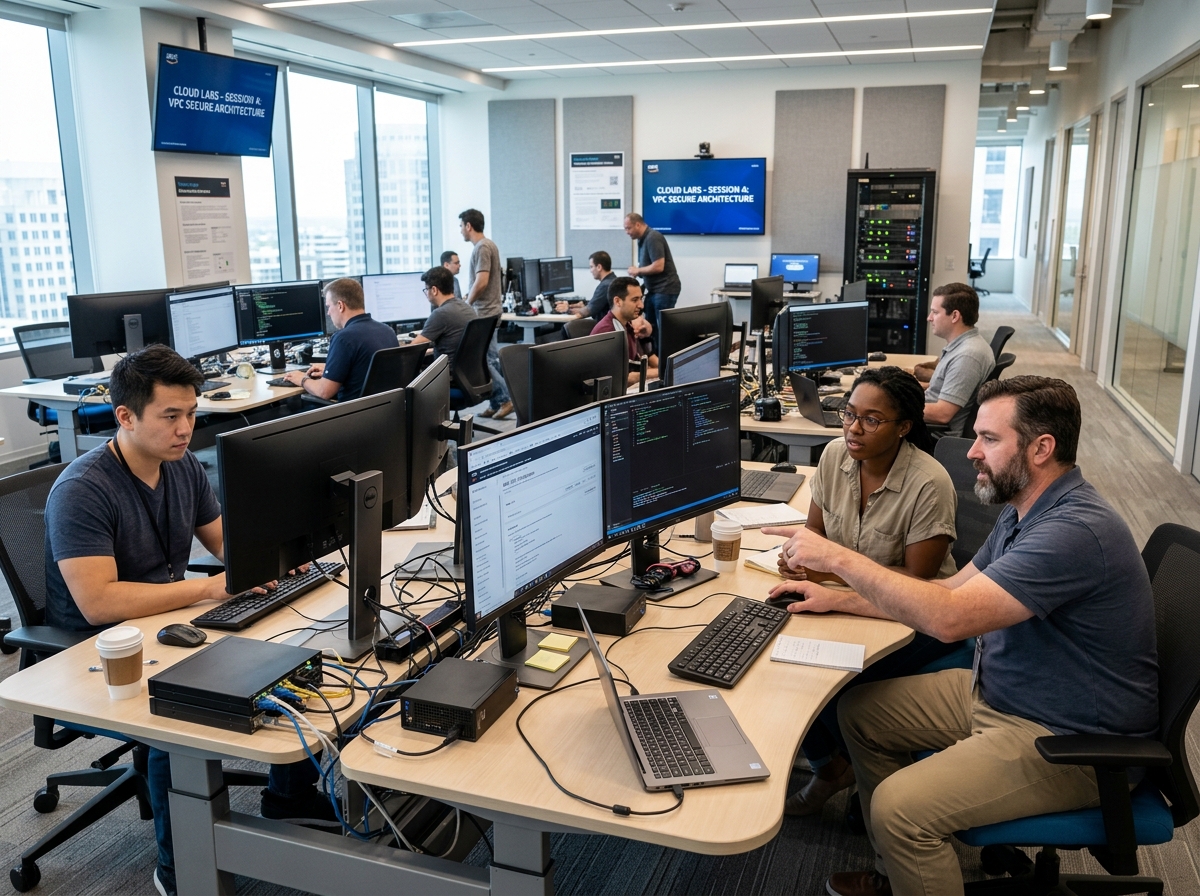
Technical and professional programs may incorporate hands-on laboratory activities. Participants may work with:
Large language models
Prompting environments
AI copilots
RAG workflows
Embeddings
Vector search
Knowledge assistants
AI agents
Workflow automation
Model evaluation
AI security scenarios
Applied labs help participants move from conceptual understanding to practical professional capability.
Module 38Generative AI Curriculum
Executive Generative AI Education
Executive programs are designed for:
Executives
Directors
Senior managers
Business leaders
Technology leaders
Board members
Government leaders
Organizational decision-makers
Rather than focusing heavily on technical implementation, executive programs may address:
Generative AI strategy
Competitive impact
AI investment
Enterprise adoption
AI governance
Responsible AI
AI risk
Cybersecurity
Workforce transformation
Regulatory considerations
Board oversight
Measuring AI business value
The objective is to help leaders make informed decisions about how to adopt, govern, fund, secure, and scale generative AI.
Module 39Generative AI Curriculum
Corporate Generative AI Training
IBACTP® may provide dedicated Generative AI training for corporate teams and organizations. Programs can be developed for:
Organization-wide AI literacy
Department-specific AI adoption
Executive leadership
Technical teams
Cybersecurity teams
Data teams
HR teams
Finance teams
Marketing teams
Operations teams
Customer-service teams
Corporate programs may be delivered virtually, onsite, in a hybrid format, or through customized learning cohorts.
Module 40Generative AI Curriculum
Customized Enterprise Generative AI Programs
Organizations with specialized requirements may request customized programs aligned with their:
Industry
AI strategy
Technology environment
Business processes
Workforce roles
Governance requirements
Security requirements
Organizational AI maturity
Regulatory environment
Customized programs may combine:
AI skills assessments
Generative AI literacy
Role-based training
Prompt engineering
AI security
AI governance
Executive education
Certification preparation
Applied workshops
Team projects
Module 41Generative AI Curriculum
Cohort-Based Training
IBACTP® may provide cohort-based Generative AI programs for organizations, universities, government agencies, professional associations, and other groups. Cohort programs may provide:
Scheduled learning
Instructor guidance
Peer collaboration
Group exercises
Applied projects
Progress milestones
Practice assessments
Certification preparation
Module 42Generative AI Curriculum
Training Delivery Options at a Glance
IBACTP® Generative AI training may be available through:
Virtual Instructor-Led Training (VILT)
Self-Paced Online Training
Live Classroom Training
Generative AI Bootcamps
Hybrid Training
Certification Preparation Programs
Hands-On Workshops
Applied AI Labs
Executive Education
Corporate Training
Customized Enterprise Training
Cohort-Based Learning
Module 43Generative AI Curriculum
Learn Generative AI Your Way
Whether you are beginning your Generative AI journey, preparing for professional certification, developing advanced technical skills, managing AI initiatives, or leading enterprise AI transformation, IBACTP® provides flexible training pathways designed around professional competency.
UNDERSTAND
PRACTICE
APPLY
SECURE
GOVERN
CERTIFY
LEAD
Flexible Learning. Applied Skills. Responsible AI. Certification-Aligned Professional Development.
Module 44Generative AI Curriculum
Who Should Attend
Suitable participants include:
AI practitioners
Business professionals
Developers
Data scientists
Cybersecurity professionals
Content and knowledge professionals
Product managers
Consultants
Managers
Executives
Educators
Technology leaders
Module 45Generative AI Curriculum
Organizational Applications
Training may address applications in:
Customer service
Cybersecurity
Data analysis
Research
Knowledge management
Software development
Marketing
HR
Procurement
Finance
Operations
Education
Executive decision support
Module 46Generative AI Curriculum
Generative AI Risk & Governance
Special attention is given to:
Privacy
Security
Bias
Intellectual property considerations
Model hallucinations
Data governance
Prompt injection
Deepfakes
Synthetic content
Responsible deployment
Human oversight
Module 47Generative AI Curriculum
Career Relevance
Potential career-development areas include:
Generative AI Specialist
AI Prompt Professional
AI Automation Specialist
AI Governance Professional
Generative AI Consultant
AI Product Manager
AI Risk Specialist
AI Security Professional
Explore Generative AI Training
Prompt Smarter. Automate Responsibly. Govern Generative AI with Confidence.